Solve For X 8x 2 5x 8

pinupcasinoyukle
Dec 03, 2025 · 8 min read
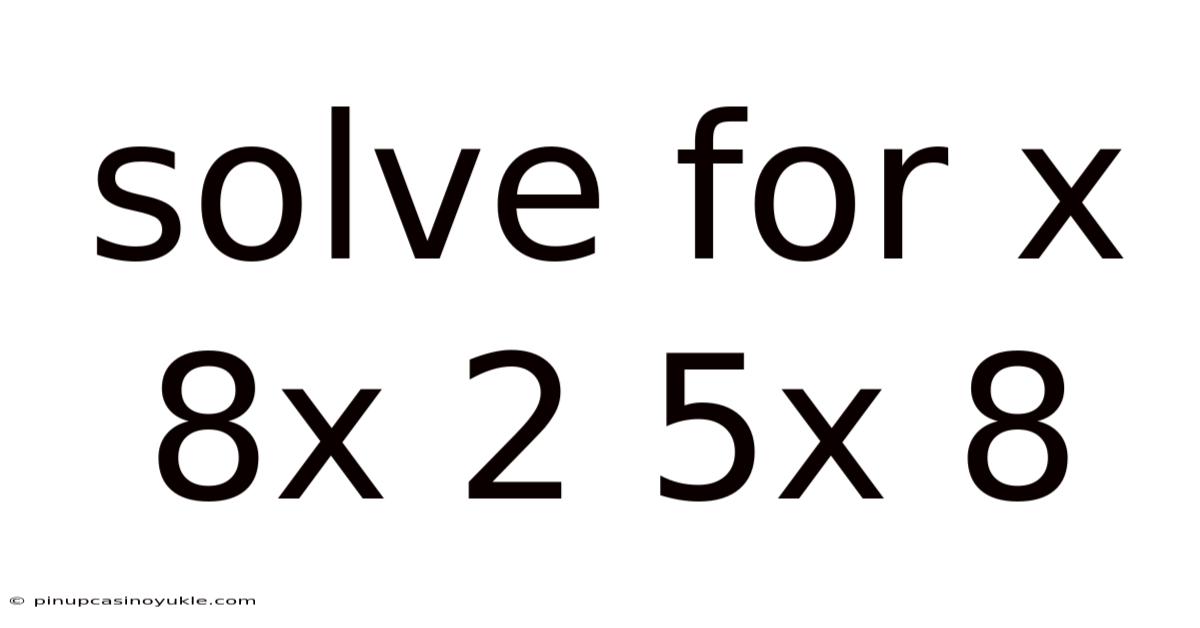
Table of Contents
Solving for x in the equation 8x + 2 = 5x + 8 involves using algebraic principles to isolate the variable x on one side of the equation. This seemingly simple task unlocks a deeper understanding of equation manipulation and problem-solving, crucial skills in mathematics and various scientific fields. Mastering this type of equation not only provides a solid foundation for tackling more complex algebraic problems but also sharpens your logical thinking and analytical abilities.
Understanding Linear Equations
Before diving into the solution, it's essential to understand what a linear equation is. A linear equation is an algebraic equation in which each term is either a constant or the product of a constant and a single variable. These equations are "linear" because when graphed, they form a straight line. The general form of a linear equation is ax + b = c, where a, b, and c are constants, and x is the variable. The equation 8x + 2 = 5x + 8 fits this description, making it a linear equation. Solving linear equations involves performing operations on both sides of the equation to isolate the variable.
Step-by-Step Solution
Let's break down the process of solving 8x + 2 = 5x + 8 into manageable steps:
-
Identify Like Terms: The first step is to recognize the terms that can be combined. In this equation, we have terms with x (8x and 5x) and constant terms (2 and 8).
-
Isolate Variable Terms on One Side: To isolate the variable terms, we need to move all terms with x to one side of the equation. The goal is to have all the x terms on either the left or the right side. A common approach is to subtract the smaller x term from both sides to avoid dealing with negative coefficients. In this case, we subtract 5x from both sides:
- 8x + 2 - 5x = 5x + 8 - 5x
- This simplifies to 3x + 2 = 8
-
Isolate Constant Terms on the Other Side: Now, we need to isolate the constant terms on the opposite side of the equation. To do this, we subtract 2 from both sides:
- 3x + 2 - 2 = 8 - 2
- This simplifies to 3x = 6
-
Solve for x: Finally, to solve for x, we divide both sides of the equation by the coefficient of x, which is 3:
- 3x / 3 = 6 / 3
- This gives us x = 2
Therefore, the solution to the equation 8x + 2 = 5x + 8 is x = 2.
Verification
To ensure the solution is correct, we can substitute x = 2 back into the original equation:
- 8*(2)* + 2 = 5*(2)* + 8
- 16 + 2 = 10 + 8
- 18 = 18
Since both sides of the equation are equal, this confirms that x = 2 is the correct solution. Verification is a crucial step in problem-solving, helping to catch any potential errors.
Alternative Approaches
While the above method is straightforward, alternative approaches can be used, particularly when dealing with more complex equations.
-
Moving Terms Differently: Instead of subtracting 5x first, you could subtract 8x from both sides. This would result in -3x + 8 = 2. Then, subtracting 8 from both sides gives -3x = -6. Finally, dividing by -3 yields x = 2. This method works just as well, although it involves working with negative numbers.
-
Combining Steps: Some individuals might combine steps for efficiency. For instance, one could subtract both 5x and 2 from both sides simultaneously:
- 8x + 2 - 5x - 2 = 5x + 8 - 5x - 2
- This directly simplifies to 3x = 6, leading to x = 2.
The key is to understand the underlying principles and choose the method that feels most comfortable and efficient for you.
Common Mistakes to Avoid
When solving equations, several common mistakes can lead to incorrect answers. Being aware of these pitfalls can help prevent errors and improve accuracy:
-
Incorrectly Combining Terms: Ensure you only combine like terms. For example, you cannot combine 8x and 2 because one is a variable term and the other is a constant.
-
Forgetting to Apply Operations to Both Sides: Any operation performed on one side of the equation must be performed on the other side to maintain equality. Forgetting this rule is a common source of errors.
-
Sign Errors: Pay close attention to signs (positive and negative). A simple sign error can drastically change the solution. For example, incorrectly subtracting a negative number can lead to an incorrect result.
-
Dividing or Multiplying by Zero: Dividing or multiplying by zero is undefined and will lead to an incorrect solution. Always avoid these operations.
-
Skipping Verification: As mentioned earlier, verification is a crucial step. Skipping it can mean missing a simple error that could have been easily corrected.
Real-World Applications
Solving linear equations like 8x + 2 = 5x + 8 isn't just an abstract mathematical exercise; it has numerous real-world applications. These equations are used to model and solve problems in various fields, including:
-
Finance: Calculating interest rates, loan payments, and investment returns often involves solving linear equations. For example, determining the number of months needed to pay off a loan with fixed monthly payments can be modeled using a linear equation.
-
Physics: Many basic physics problems, such as calculating velocity, distance, or time, involve linear equations. For instance, if you know the initial velocity, acceleration, and final velocity of an object, you can use a linear equation to find the time it took to reach that final velocity.
-
Engineering: Engineers use linear equations extensively to design structures, analyze circuits, and control systems. For example, determining the amount of force needed to support a bridge can involve solving a system of linear equations.
-
Economics: Economists use linear equations to model supply and demand, analyze market trends, and make predictions about economic growth. For example, determining the equilibrium price of a product can involve solving a linear equation.
-
Computer Science: Linear equations are fundamental in computer graphics, machine learning, and algorithm design. For example, linear regression is a widely used technique in machine learning that involves solving a linear equation to find the best-fit line for a set of data points.
Building a Strong Foundation
Mastering the skill of solving linear equations is crucial for building a strong foundation in mathematics and related fields. It's not just about memorizing steps; it's about understanding the underlying principles and developing the ability to apply them to various problems. Here are some tips for strengthening your understanding:
-
Practice Regularly: The more you practice, the more comfortable you'll become with the process. Solve a variety of linear equations with different coefficients and constants.
-
Understand the Concepts: Don't just memorize the steps; understand why each step is necessary. Knowing the reasoning behind each operation will help you apply the principles to more complex problems.
-
Work Through Examples: Study worked-out examples to see how different types of equations are solved. Pay attention to the strategies used and the common mistakes to avoid.
-
Seek Help When Needed: Don't hesitate to ask for help from teachers, tutors, or classmates if you're struggling with a particular concept or problem.
-
Use Online Resources: There are many excellent online resources, such as websites, videos, and interactive tutorials, that can help you learn and practice solving linear equations.
-
Apply to Real-World Problems: Look for opportunities to apply your knowledge to real-world problems. This will help you see the relevance of mathematics and make it more engaging.
Expanding Your Knowledge
Once you've mastered solving basic linear equations, you can expand your knowledge by exploring more advanced topics:
-
Systems of Linear Equations: These involve solving multiple linear equations simultaneously. Techniques like substitution, elimination, and matrix methods can be used to solve systems of linear equations.
-
Quadratic Equations: These are equations of the form ax² + bx + c = 0. Solving quadratic equations involves techniques like factoring, completing the square, and using the quadratic formula.
-
Polynomial Equations: These are equations involving polynomials of higher degrees. Solving polynomial equations can be more challenging and may require techniques like factoring, synthetic division, and numerical methods.
-
Inequalities: These involve comparing expressions using symbols like <, >, ≤, or ≥. Solving inequalities involves similar techniques to solving equations, but with some important differences.
-
Linear Algebra: This is a branch of mathematics that deals with vectors, matrices, and linear transformations. Linear algebra is essential for many applications in science, engineering, and computer science.
Conclusion
Solving for x in the equation 8x + 2 = 5x + 8 is a fundamental skill in algebra. By following the steps outlined above, you can confidently solve this type of equation and build a strong foundation for more advanced mathematical concepts. Remember to practice regularly, understand the underlying principles, and seek help when needed. With dedication and perseverance, you can master the art of solving equations and unlock the power of mathematics. The applications of these skills extend far beyond the classroom, influencing fields from finance and physics to engineering and computer science. Mastering linear equations is not just about finding the right answer; it's about developing critical thinking skills and analytical abilities that will serve you well in all aspects of life.
Latest Posts
Related Post
Thank you for visiting our website which covers about Solve For X 8x 2 5x 8 . We hope the information provided has been useful to you. Feel free to contact us if you have any questions or need further assistance. See you next time and don't miss to bookmark.
