1/4 X 1/4 X 1/4 X 1/4

pinupcasinoyukle
Dec 01, 2025 · 10 min read
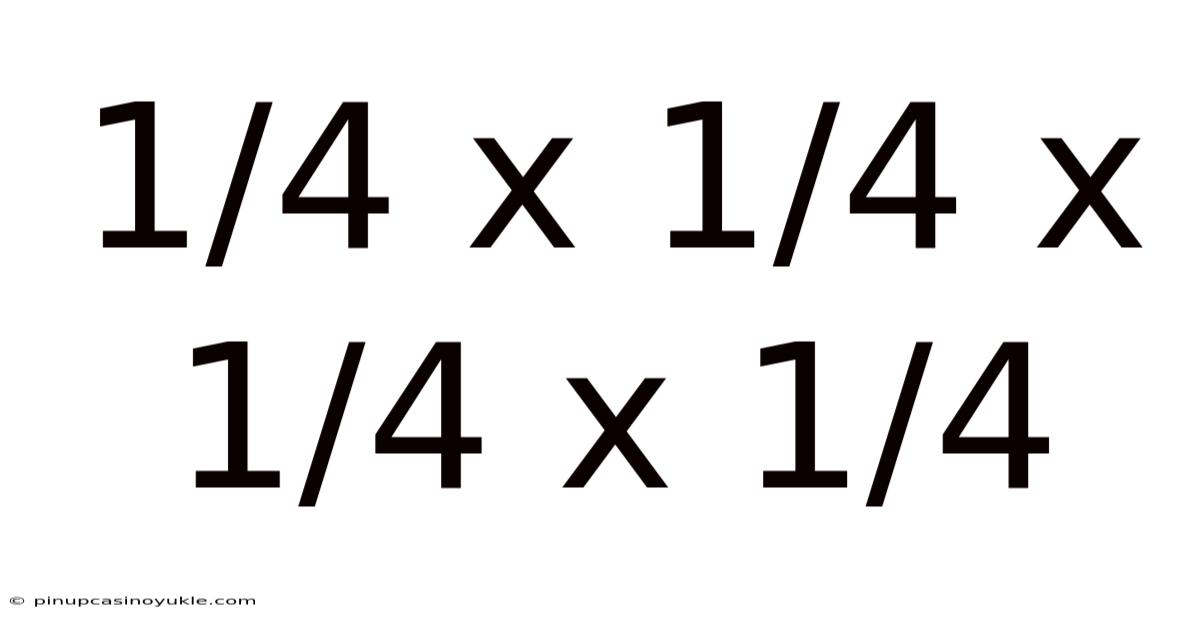
Table of Contents
Multiplying fractions might seem daunting at first, but it becomes surprisingly straightforward once you grasp the basic principles. The problem 1/4 x 1/4 x 1/4 x 1/4 offers an excellent opportunity to understand how repeated multiplication of fractions works, leading to a deeper appreciation for mathematical operations and their real-world applications.
Understanding Fraction Multiplication
To multiply fractions, you simply multiply the numerators (the top numbers) together and then multiply the denominators (the bottom numbers) together. The resulting fraction is the product of the two original fractions. This principle applies regardless of how many fractions you are multiplying.
Basic Rule: (a/b) x (c/d) = (a x c) / (b x d)
Step-by-Step Calculation of 1/4 x 1/4 x 1/4 x 1/4
Let’s break down the calculation step by step:
-
First Multiplication: 1/4 x 1/4
- Multiply the numerators: 1 x 1 = 1
- Multiply the denominators: 4 x 4 = 16
- Result: 1/16
-
Second Multiplication: 1/16 x 1/4
- Multiply the numerators: 1 x 1 = 1
- Multiply the denominators: 16 x 4 = 64
- Result: 1/64
-
Third Multiplication: 1/64 x 1/4
- Multiply the numerators: 1 x 1 = 1
- Multiply the denominators: 64 x 4 = 256
- Result: 1/256
Therefore, 1/4 x 1/4 x 1/4 x 1/4 = 1/256.
Visualizing the Multiplication
Visual aids can be incredibly helpful in understanding mathematical concepts. Let's visualize what multiplying 1/4 by itself four times means.
Imagine a square. This square represents 1 whole unit.
-
First Multiplication (1/4 x 1/4):
- Divide the square into four equal parts. Each part represents 1/4.
- Now, take one of those parts (1/4) and divide it again into four equal parts.
- Each of these smaller parts represents 1/16 of the original square.
-
Second Multiplication (1/16 x 1/4):
- Take one of the 1/16 parts and divide it into four equal parts.
- Each of these even smaller parts now represents 1/64 of the original square.
-
Third Multiplication (1/64 x 1/4):
- Finally, take one of the 1/64 parts and divide it one last time into four equal parts.
- Each of these tiniest parts represents 1/256 of the original square.
This visualization demonstrates how each multiplication by 1/4 reduces the size of the fraction, leading to the final result of 1/256.
Understanding the Power of Exponents
Repeated multiplication can also be expressed using exponents. In this case, multiplying 1/4 by itself four times is the same as raising 1/4 to the power of 4.
(1/4)^4 = 1/4 x 1/4 x 1/4 x 1/4
Using the exponent rule, we can write:
(1/4)^4 = 1^4 / 4^4
- 1^4 = 1 x 1 x 1 x 1 = 1
- 4^4 = 4 x 4 x 4 x 4 = 256
So, (1/4)^4 = 1/256
This approach not only simplifies the calculation but also introduces a more abstract and powerful way of representing repeated multiplication.
Real-World Applications
While multiplying fractions like 1/4 x 1/4 x 1/4 x 1/4 might seem purely academic, it has practical applications in various fields.
-
Probability:
- Consider a scenario where you have a spinner divided into four equal parts, each representing a different outcome.
- If you spin the spinner four times, the probability of landing on a specific outcome each time is 1/4.
- The probability of landing on that specific outcome four times in a row is (1/4) x (1/4) x (1/4) x (1/4) = 1/256.
-
Scaling and Proportions:
- In cooking, if you need to reduce a recipe by a quarter four times in a row, you would multiply the original ingredient amounts by 1/4 four times.
- For example, if a recipe calls for 1 cup of flour, reducing it four times by a quarter would result in 1/256 cup of flour.
-
Computer Science:
- In image processing, resizing an image to 1/4 of its original size four times consecutively involves multiplying the dimensions by 1/4 four times.
- This can be useful for creating thumbnails or reducing the resolution of an image for web use.
-
Engineering:
- When designing structures, engineers often need to calculate stress and strain on materials.
- If a material's strength is reduced by 1/4 at each successive layer or component, repeated multiplication of 1/4 is necessary to determine the overall structural integrity.
Common Mistakes to Avoid
When multiplying fractions, it's easy to make mistakes if you're not careful. Here are some common pitfalls to avoid:
-
Adding Instead of Multiplying:
- A common mistake is to add the numerators and denominators instead of multiplying.
- For example, incorrectly calculating 1/4 x 1/4 as (1+1)/(4+4) = 2/8 = 1/4.
- Remember, you must multiply the numerators and denominators.
-
Forgetting to Simplify:
- Although 1/256 is already in its simplest form, always check if the resulting fraction can be simplified.
- Simplifying fractions involves dividing both the numerator and denominator by their greatest common divisor (GCD).
-
Incorrectly Applying Exponents:
- When using exponents, ensure you apply the exponent to both the numerator and the denominator.
- For example, (1/4)^4 should be calculated as 1^4 / 4^4, not just 1 / 4^4.
-
Misunderstanding Whole Numbers:
- When multiplying a fraction by a whole number, remember to treat the whole number as a fraction with a denominator of 1.
- For example, 3 x 1/4 is the same as 3/1 x 1/4 = 3/4.
Advanced Concepts
To further enhance your understanding, let's explore some related mathematical concepts.
-
Reciprocals:
- The reciprocal of a fraction is obtained by swapping the numerator and denominator. For example, the reciprocal of 1/4 is 4/1, or simply 4.
- Multiplying a fraction by its reciprocal always results in 1. For example, (1/4) x 4 = 1.
-
Dividing Fractions:
- Dividing fractions is the same as multiplying by the reciprocal of the divisor.
- For example, to divide 1/2 by 1/4, you multiply 1/2 by the reciprocal of 1/4, which is 4.
- So, (1/2) ÷ (1/4) = (1/2) x 4 = 2.
-
Mixed Numbers and Improper Fractions:
- A mixed number is a combination of a whole number and a fraction, such as 2 1/2.
- An improper fraction is a fraction where the numerator is greater than or equal to the denominator, such as 5/2.
- Before multiplying or dividing mixed numbers, it's often easier to convert them to improper fractions.
-
Complex Fractions:
- A complex fraction is a fraction where the numerator, denominator, or both contain fractions.
- To simplify a complex fraction, multiply the numerator and denominator by the least common denominator (LCD) of all the fractions involved.
Practice Problems
To solidify your understanding, try solving these practice problems:
- Calculate 1/2 x 1/2 x 1/2 x 1/2 x 1/2.
- Calculate (2/3)^3.
- A recipe calls for 3/4 cup of sugar. If you want to make 1/3 of the recipe, how much sugar do you need?
- What is the probability of flipping a coin and getting heads three times in a row?
- Simplify the expression (1/5 x 1/5) / (1/25).
The Significance of Understanding Fractions
Understanding fractions is not just about performing calculations; it's about developing a deeper sense of numerical literacy. Fractions are integral to:
- Problem-solving: Many real-world problems involve proportional reasoning, which relies on understanding fractions.
- Critical thinking: Working with fractions enhances your ability to analyze and interpret data.
- Mathematical foundation: Fractions are the building blocks for more advanced mathematical concepts, such as algebra and calculus.
Conclusion
Multiplying 1/4 x 1/4 x 1/4 x 1/4 equals 1/256. This seemingly simple calculation provides a gateway to understanding fundamental principles of fraction multiplication, exponents, and their practical applications. By visualizing the multiplication, avoiding common mistakes, and exploring related concepts, you can build a strong foundation in mathematics and enhance your problem-solving skills. Remember, consistent practice and a clear understanding of the underlying principles are key to mastering fraction multiplication and unlocking the power of mathematical reasoning.
Frequently Asked Questions (FAQ)
-
Why do we multiply numerators and denominators when multiplying fractions?
- Multiplying numerators and denominators is the fundamental rule for multiplying fractions. When you multiply fractions, you're essentially finding a fraction of a fraction. Multiplying the numerators gives you the portion of the whole you're interested in, while multiplying the denominators determines the size of the new whole.
-
Can I use a calculator to multiply fractions?
- Yes, calculators can be helpful for multiplying fractions, especially when dealing with larger numbers. However, it's essential to understand the underlying principles so you can estimate the answer and check if the calculator's result is reasonable.
-
What if I have a mixed number to multiply?
- Convert the mixed number to an improper fraction before multiplying. For example, if you need to multiply 2 1/2 by 1/4, convert 2 1/2 to 5/2 first, then multiply 5/2 x 1/4 = 5/8.
-
How does multiplying fractions relate to percentages?
- Fractions and percentages are closely related. A percentage is essentially a fraction with a denominator of 100. For example, 25% is equivalent to 25/100, which simplifies to 1/4. Therefore, multiplying by a fraction like 1/4 is the same as finding 25% of a number.
-
Is there a shortcut for multiplying the same fraction multiple times?
- Yes, using exponents is a shortcut. If you're multiplying the same fraction n times, you can raise the fraction to the power of n. For example, 1/4 x 1/4 x 1/4 x 1/4 = (1/4)^4 = 1/256.
-
What is the importance of simplifying fractions after multiplication?
- Simplifying fractions ensures that the result is expressed in its most basic and understandable form. It involves dividing both the numerator and the denominator by their greatest common factor (GCF) until no further division is possible. This not only makes the fraction easier to interpret but also helps in comparing it with other fractions or performing further calculations.
-
How do I multiply more than two fractions together efficiently?
- When multiplying multiple fractions, you can multiply all the numerators together to get the final numerator and all the denominators together to get the final denominator. For example, to multiply 1/2 x 2/3 x 3/4 x 4/5, you can multiply (1 x 2 x 3 x 4) / (2 x 3 x 4 x 5) which equals 24/120. Then, simplify the result to its simplest form.
-
Can I cancel out common factors before multiplying fractions?
- Yes, you can simplify calculations by canceling out common factors between the numerators and denominators before multiplying. This can make the multiplication process easier, especially when dealing with larger numbers. For example, in the expression (2/3) x (3/4), you can cancel out the common factor of 3 before multiplying, resulting in (2/1) x (1/4) = 2/4, which simplifies to 1/2.
-
How are fractions used in everyday life beyond the examples mentioned?
- Fractions are used in various aspects of daily life, such as measuring ingredients in cooking, determining discounts in shopping (e.g., 20% off), calculating time (e.g., half an hour), understanding proportions in mixing solutions, and interpreting data in charts and graphs. Understanding fractions helps in making informed decisions and solving practical problems in numerous scenarios.
-
What are some tips for teaching fraction multiplication to students?
- Use visual aids: Diagrams, fraction bars, and real-world objects can help students visualize the concept.
- Start with simple examples: Begin with multiplying fractions with small numerators and denominators.
- Relate to real-life scenarios: Use examples that students can relate to, such as sharing pizza or dividing tasks.
- Encourage practice: Provide plenty of practice problems to reinforce the concept.
- Address common misconceptions: Correct mistakes immediately and explain the reasoning behind the correct answer.
Latest Posts
Related Post
Thank you for visiting our website which covers about 1/4 X 1/4 X 1/4 X 1/4 . We hope the information provided has been useful to you. Feel free to contact us if you have any questions or need further assistance. See you next time and don't miss to bookmark.
